

LIVING INDUCTEE
RALPH BEER
DISTRICT 8 - YEAR 2027
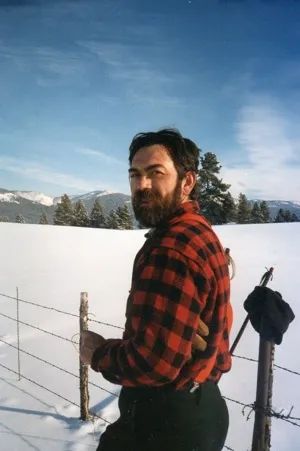
Novelist, essayist, and rancher Ralph Beer lives with his wife, Maggie, in Northern Colorado, along the Rocky Mountain foothills midway between Fort Collins and Laramie, Wyoming.
He moved there after grudgingly selling the family ranch on Jackson Creek south of Helena in 2000. He readily admits he and Maggie miss the cows.
Ralph Robert Beer was born to Howard R. Beer and Ellen Louise (Davis) Beer in 1947. He is of the fifth generation in Montana. His people came from England and Wales, first landing in the Montana territory near the headwaters of the Missouri River just after the American Civil War, and eventually settled near Helena beginning in the late 1800s. They arrived, as the writer William Kittridge tells it, “…to farm and raise livestock, seeking economic opportunity and the possibility of freedom.”
Ralph attempted to maintain the opportunities and possibilities of the Beer Ranch, to hold to the land, for more than 50 years. It’s been his life’s work to chronicle the responsibilities and consequences of that struggle, and by extension the struggle of Montana’s rural communities.
In 1986, in a review of Ralph’s first novel, The Blind Corral, The New Yorker noted that, “Mr. Beer is one of a new breed of contemporary writers, native to the mountain West, who find their themes in a feel for the land and the natural world and in the death threats of urbanization, and he is one of the best of them—a writer gifted with both strength and grace.”
He is the author of four books, mostly or partially set in Montana, the novel The Blind Corral (1986); two essay collections, In These Hills (2000) and The Jackson Creek Road (2016); and a memoir, Afternoon Light (2016). His thematic focus honors Montana and its rural lifeways and communities—and, perhaps most significantly, eulogizes their rapid disappearance.
In 1986, Ralph was awarded The Spur Award by the Western Writers of America for The Blind Corral. The previous year, the WWA honored Larry McMurtry’s Lonesome Dove. In These Hills was the recipient of the Western States Book Award for Creative Nonfiction in 2000. Montana—the Magazine of Western History called that effort a “moving tribute to Western rural life.” At its core, Ralph’s work is ever cognizant of the march of progress, the utilitarian fascination for tractors over horse teams, but like the Kentucky poet Wendell Berry, he holds a reverence for the land close to his heart and aggressively defends the work and tools that define Western agrarian culture.
Ralph’s friend, rodeo poet Paul Zarzysky (Montana Cowboy Hall of Fame 2024), neatly encapsulates Ralph’s lifework: “No one has written more poignantly and painterly about day-to-day, chore-to-chore, loss-to-loss, small-outfit life in the ranching West than Ralph.”
Indeed. Consider this elegiac passage from Ralph’s 1985 Harper’s Magazine essay, “Holding to the Land—A Rancher’s Sorrow”:
“Imagine in the heart of Montana, where my father and I ranch, and where we farm a hundred acres of dry-land hay ground—land cleared one stump at a time by my grandfather and his father with two-man crosscut saws, dynamite, and teams of Belgian horses.
“This has been cattle country for a hundred years, though in certain places terraced buffalo trails still contour the muscled hills. It’s country that can wear you out and make you proud, make you exult in what is and what isn’t there…In the 1980s, however, the name of the game has become change—rapid change which is accelerating beyond our wildest whiskey dreams.”
Ralph has occasionally drifted off to write joyfully about pickup trucks and what he’s called a “motorcycle lust.” He also wrote about the prolonged, disconnected generational malaise brought about by Montana boys testing their skill in love and against the wildness of British Columbia, Canada. There he and a young love set out together to build a log cabin from standing timber to completion in those big woods. Ralph wrote how they felled timber, put up hay, and butchered cattle—all on the corroding cusp and aftermath of the Vietnam War, specifically in The Blind Corral and Afternoon Light. After being drummed out of Canada, Ralph spent three years in the U.S. Army, mostly at Fort Sill, Okla., followed by a year at a top-secret joint command intelligence operation in Thailand. Of the Vietnam War era, Ralph called it “the event of my generation, whether we think much about it now or not…” and “…a tragic and senseless waste for us all.”
In his fiction and essays, there is always a prescient sense of what’s in store, the consequences just round the bend. It is, of course, the metaphorical blind corral, the unseen trap that leads an unsuspecting culture, like cattle, to a holding pen with no apparent exit. “Here on Jackson Creek,” Ralph writes in his 1985 Harper’s Magazine essay, “we’ve come to worry not only that greedy outsiders will try to take control of our land, but that one of the adjoining ranches will sell, opening the floodgates for development right on the creek.”
In a 30-year-hence postscript, Ralph writes, “In the Jackson Creek area of central Montana, rural subdivision continued at a rapid pace…Two of the three ranches on the creek have been sold. Half of one place has been subdivided. My wife and I sold the ranch in 2000.”
Ralph attended and graduated from Helena elementary and secondary schools. He earned a Bachelor of Arts degree from Montana State University in 1971 and later a Master of Fine Arts from the University of Montana. He taught writing at Carroll College in Helena. In addition to his books, Ralph’s work is included in Montana Spaces (1988) and the heralded collection, The Last Best Place—A Montana Anthology (1990). He was a contributing editor at Harper’s Magazine and wrote the “Ranch Life” column at Big Sky Journal.
In a recent letter to a friend, Ralph lamented a bit about his concentration on literary ambitions. “I sometimes wonder about the strange dream I lived through from the late ‘70s to the mid-‘80s,” he wrote. “Learning to write well seemed like the only darned thang. Now I’m not so sure.”
There is little doubt that a talent like Ralph Beer emerges with a rarity so evanescent it does appear to be a dream. But his conceit that our Montana identity, the Western identity of myth, legend and reality, is tied to one thing: to live a conscious, moral life, we are compelled to live righteously in this place, on this land.
Resource: Writer Tom Palmer