

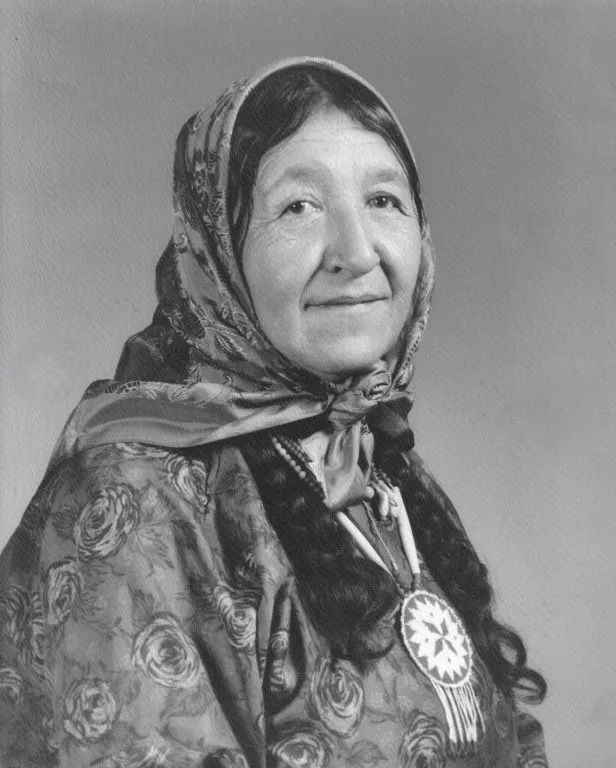
LEGACY INDUCTEE
SUSIE WALKING BEAR YELLOWTAIL (1903-1981)
BAALÓ PUUSHÉ IAXPÁALIA, MEDICINE SPOTTED BEADS
DISTRICT 7 – YEAR 2027
Susie Walking Bear Yellowtail exemplifies the qualities of an honorable Apsáalooke Crow woman and Montanan. A trailblazing nurse, nurturer of her people and outspoken advocate for Native American women, children and reform of Native health, education and welfare, Susie was an effective and highly respected ambassador, walking in the two worlds of Crow traditional culture and white civilization, bridging them to create meaningful change that resonates today.
Susie’s life story is truly one of survival, resilience and adaptation in a time of extreme adversity. She was born in 1903 on the Crow Indian Reservation in Pryor, Montana to Walking Bear and Jane Whitehorse (Fools and Kills the Enemy) during a challenging time of extreme cultural upheaval, displacement and poverty for the Crow people. Despite forceful government assimilation policies designed to obliterate Crow culture, Susie was raised in a community that deeply valued the continuity of cultural traditions which gave her a life-long foundation of core Crow values and cultural identity. She was forcibly taken from her parents at age eight to attend Pryor Government Boarding School. Orphaned at the young age of ten, she was then sent to Crow Agency Government Boarding School. An avid learner, she refused an arranged marriage at age 16 and continued her education at Bacone Baptist School in Oklahoma. A few years later Susie was invited by a Baptist missionary to Massachusetts where she attended Northfield Seminary and worked as the family’s maid and nanny in exchange for room and board. After experiencing abuse and hardship, Susie enrolled in the Franklin County Public Hospital School of Nursing in Massachusetts, and received her Registered Nurse degree with honors in 1927, thus becoming the first Apsáalooke and one of the first Native American R.N.’s in the United States.
Absent for ten years, Susie returned to the Crow Reservation as Head Nurse at Crow Agency Indian Health Service (IHS) Hospital. During this tenure, she witnessed many atrocities and mistreatment’s, including the nationally practiced genocidal sterilization of Native women without consent, a procedure she herself experienced after her third child. She took a fierce stand, often going toe-to-toe with white Doctors and nurses defending her Crow patients. Cultural differences between modern and traditional Crow medicine at the time also rend deep distrust in conventional Western medicine. As a Crow nurse, Susie actively advocated for the patients and encouraged them to seek professional medical care. From her first-hand experiences Susie pressed for reforms in the IHS and beyond throughout her lifetime.
Susie married Thomas Yellowtail in 1929 and for the first few years they lived in canvas wall tents near Wyola, Montana, often with extended family. Enduring the hardships of extreme Montana winters the family first subsisted on scarce game meat and bread with flour gravy. Eventually, life improved as they began to raise and process their own food- a survival skill, along with cooking and sewing, she attributed to their early boarding school education. While raising four children- Virjama, Bruce, Constance and adopted son, T.R. Glenn, Susie worked alongside her husband, as they supplemented their meager income raising sugar beets, and selling cream, butter and eggs. It was from her husband’s mother Lizzie and aunt Mary, that she eagerly relearned Crow traditional ways which had been absent from her life since a young girl. She regained fluency in the Crow language, hide tanning, beadwork, sewing, traditional clothing and traditional foods and plant medicines- all valued Crow practices she continued throughout her life.
During this time Susie continued her nursing career on her own terms as a practicing midwife and visiting home nurse to Crow and non-natives alike across the reservation. After her children began school, Susie began traveling extensively as cultural ambassador and advocate for the improvement of the lives of Native Tribes nationwide. She performed in a Goodwill Dance Troupe for the State Department in Europe and the Middle-East, and was the official Miss Indian America Chaperon for many years, bridging racial divides while promoting the causes of Native American Women. As an Apsáalooke woman, Susie was often a minority in a generally male, white dominated political environment, but drew upon her personal and professional experiences to bravely fight, gain respect and make her voice and demands for change heard. She served on many Crow Tribal, Governor’s and President’s Indian Health, Education and Welfare Advisory Boards including advisor to the Surgeon General under the Kennedy, Johnson, Nixon and Ford administrations. She was an outspoken advocate for the protections of Native children and helped shape federal policy which resulted in the Indian Child Welfare Act and was founding member of American Indian Nurses Association (AINA) which served to advance Native health and recruit young Native women into nursing. Her work with organizations like the National Congress of American Indians was instrumental in pushing for reforms in healthcare, education, and civil rights for Native peoples. A powerful orator, Susie, was also a featured speaker at state and national conventions, inspiring change and calls-to-action for government policy reform.
Susie’s accolades for her remarkable service include numerous prestigious Presidential awards; Mrs. Indian America title; Grandmother of American Indian Nurses Award from the American Indian Nurses Association; induction into the Montana Hall of Fame and the first Native American nurse to be inducted into the American Nursing Association’s Hall of Fame. Susie’s far-reaching influences have been referenced in numerous publications, and she was one of three influential women featured in the 2022 documentary film, The Story of Us: The Women Who Shaped Montana. Her life story as told to and edited by Marina Weatherly is currently being prepared for publication.
The Yellowtail couple’s life reflects their shared commitment to preserving and promoting Crow cultural and spiritual traditions and using their Western education to their advantage, thus compatibly embracing both worlds. After Thomas became a Sundance leader and traditional healer, Susie took on the challenging role as his right-hand woman and helper. As a trained R.N and one of the first Crow women Sundancer’s, she believed conventional medicine and traditional healing practices effectively went hand-in-hand, expressing her belief in the potential and value for cultural bridge-building. Mrs. Yellowtail passed away in 1981 and left behind a remarkable legacy that produced positive change in the face of adversity, continues to inspire generations and is undoubtedly deserving of a place of prominence in the Montana Cowboy Hall of Fame.
Resources:
Interviews:
- Yellowtail, Susie. Oral interviews conducted by Marina Weatherly, January-July 1980.
- Medicine Crow, Joe. Oral interview with nephew of Mrs. Yellowtail, conducted by Marina Weatherly, Spring 1980.
- Yellowtail Family. Oral interviews with children of Susie Yellowtail conducted by Marina Weatherly: Virjama Wyles, Bruce Yellowtail, Constance Jackson. Winter/Spring 1980.
- Yellowtail Family. Oral Interviews with grandchildren: Jackie Yellowtail (1995 and 2025), Leslie Jackson (2025), Valerie Jackson (2025).
Misc.:
- Yellowtail Family collection of Susie Yellowtail’s diaries, letters and notes.
- Jackson, Connie. Personal Letters and correspondence to Marina Weatherly. 1992-2018.
Publications:
Cohen, Betsy. 100 Montanans: Our Pick of the Most Influential Figures of the 20th Century. Susan Walking Bear Yellowtail. Missoulian, Sunday, October 24, 1999. Pg. M-50.
Hinkell, Therese. Susie Walking Bear Yellowtail: Nurse of the 20th Century. Privately published, 2000.
Kohl, Martha, Editor. Beyond Schoolmarms and Madams: Montana Women’s Stories. Ferguson, Laura. Susie Walking Bear Yellowtail: Our Bright Morning Star. Montana Historical Society Press, 2016. Pgs.133-135.
Lincoln, Marga. Montana Grit: Ten Unsung Heroes Who Dared to Make a Difference. Ch. 7, Nursing Trailblazer: Susie Walking Bear Yellowtail. Farcountry Press, Helena MT, 2023. Pgs. 85-96.
Theobald, Brianna. Nurse, Mother, Midwife- Susie Walking Bear Yellowtail and the Struggle for Crow Women’s Reproductive Autonomy. Montana: The Magazine of Western History. 66, no. 3. Autumn 2016. Pgs.17-35.
Film/Video:
The Story of Us: The Women Who Shaped Montana. Produced by NXBNW and Extreme History Project. 2022. Aired 10/19/2022, Rocky Mountain PBS.
https://www.pbs.org/video/story-of-us-the-women-who-shaped-montana-c2njhf
Note: A documentary film about three influential women who played important roles in the development of the State of Montana: Sarah Bickford, Maggie Smith Hathaway and Susie Walking Bear Yellowtail. (Susie Yellowtail 18.01)