

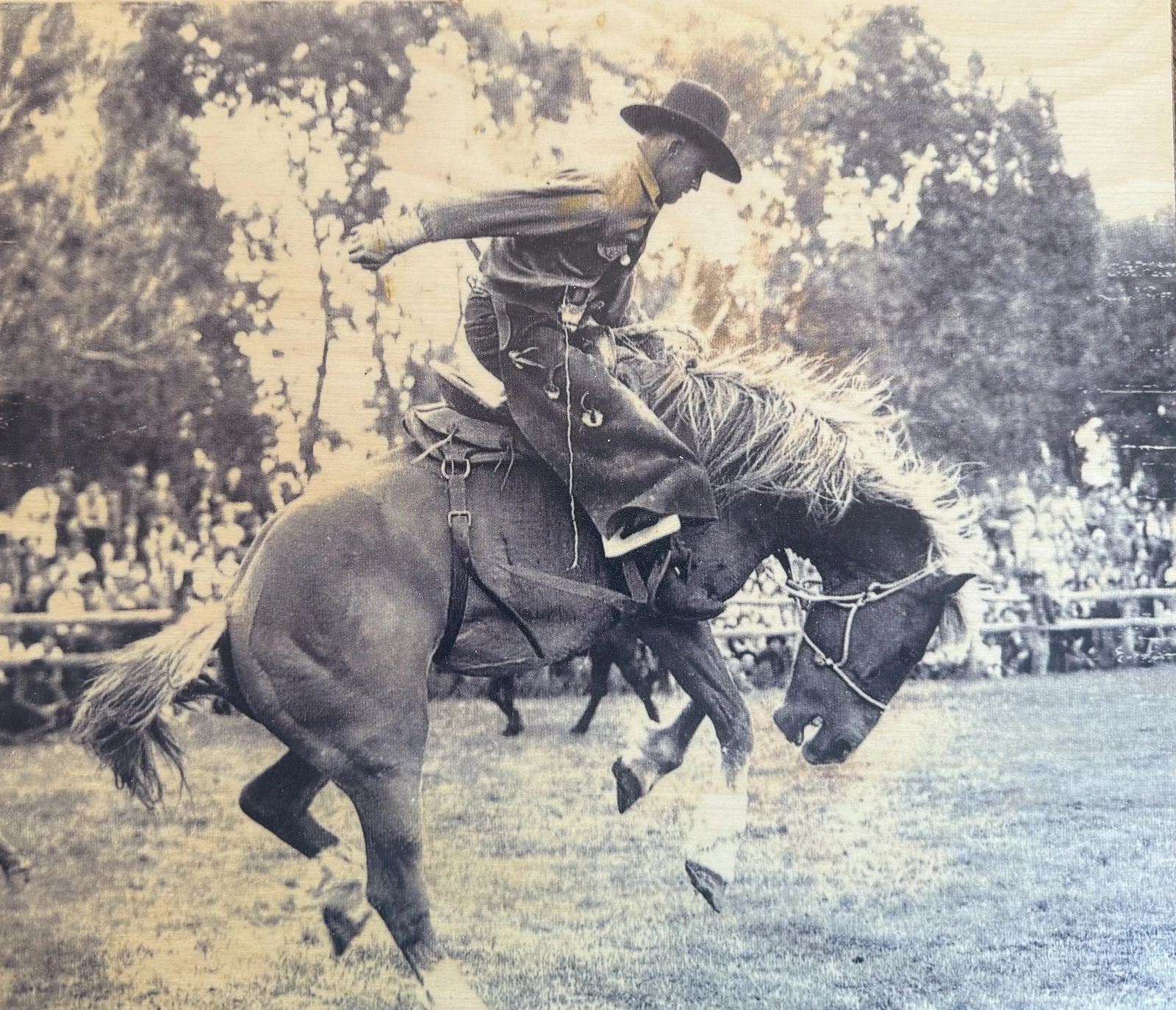
LEGACY INDUCTEE
HILARY FULTON GOLLEHON (1911 – 1995)
DISTRICT 5 – YEAR 2027
Hilary Fulton Gollehon was born in Chilhowie, Virginia, to George Fulton and Lonnie Etta (Faris) Gollehon on January 24, 1911. In 1916, when Hilary was five and his brother, Leon, was two, the family traveled to Montana and acquired a relinquished homestead 16 miles east of Brady, Montana. They had moved to the area to join relatives that had settled there earlier. Life was challenging on their dryland farm; making improvements while trying to earn a living was an even greater hardship. Water had to be hauled from the river by horse drawn wagon. Since horses were a major part of their working lives, Hilary learned early on how to handle horses and realized he had a natural way with them. Because of drought years and a growing family, which included Margaret, born in 1917 and Kenneth in 1919, the Gollehons couldn't make a go of it on their homestead. They moved to a farm three miles south of Brady for more productive land and sustainable opportunities.
In 1928, George passed away. Hilary was only 18 and now with three younger brothers, which included George Jr. in 1927, and his younger sister. He worked for surrounding neighbors, becoming well-known as a good hand with a horse. Hilary also helped his mother as much as time would allow.
In those days in Pondera County, owners turned out their horses for the winter when they weren't needed and rounded them up the next spring when work started. There were also horses abandoned by homesteaders when they went broke and moved away. Over time, the horse herd became substantial. Hilary and Leon were often called upon to help their neighbors retrieve their own horses from this large herd and then called upon to break them for farm and ranch work.
The herd continued to expand in numbers, as more and more farms started using tractors. Studs and mares had been turned out together, increasing the herd to nearly 600 head, which now also included colts. The county commissioners decided something needed to be done to take care of the herd size, so Hilary and Leon were hired to be on a round-up crew.
First order of business was castrating the studs to reduce the in-fighting. The crew would gather the horses in smaller bunches, rope and cut the studs and bob their tails because you could sell the tail hair for padding in seats for buggies and household furniture. The bunches were then moved to a holding area until all the horses were rounded up. One day the crew was moving 50 to 60 horses to a holding pasture, pushing them down a road with a fence on both sides. They didn't plan ahead to have a rider in front to turn the herd into the pasture. Hilary was riding a good horse so he decided he would try to turn them. Since he was in the back of the herd and didn't want to ride next to the fence for fear of getting pushed into it, he rode up through the middle of the bunch. They were traveling at a pretty good clip and about the time Hilary was almost to the front, his horse tripped and went down with him while the whole herd passed over him. When it was all over, he was a little shaken from the fall but it became apparent that all the horses either jumped over him or around him because to the relief of all, he was unhurt. Once all the horses were corralled in Brady, people could claim them if they had their brand on them or if they had a tax receipt proving ownership. Otherwise, they or the public could buy them from the county for $5 a head.
Around 1930, rodeos were becoming popular at dude ranches for local entertainment. Hilary learned that he could make some extra money riding bucking broncs and sometimes mules. At that time, you could get on as many as you wanted and you either rode till you fell off or until the horse quit bucking. You were scored on how long and how well you rode. At one rodeo at Twin Lakes, west of Choteau, Hilary rode five different horses and never bucked off. At another rodeo at Fort Benton, the arena was made by parking cars in a half-circle with the opposite side being the Missouri River cutbank. Hilary rode his bronc until it headed for the cutbank, bailing off just before that darn broomtail jumped off the bank into the river. Some of his cowboy friends rode downstream to a bridge and roped that bronc to pull him to shore so Hilary could get his saddle back. Hilary continued to enter a few local rodeos well into his 50s. At one rodeo in 1965, he placed in the team tying, and his daughter Sandra placed in the barrel racing, and his son, Wayne and cousin Tom, won the wild cow milking. It made for a great family memory.
In the 1940s, the Montana Fish & Game were trying to repopulate areas with mountain goats. There were a lot of goats west of Choteau so Hilary went to work for the dude rancher that was contracted to trap and pack the goats out of the mountains. They baited the goats with salt in a make-shift trap. Hilary would hide and close the gate when the goats came in. Then they would rope them, tie them up and put them in wooden crates to pack on horses or mules and move them to a trailhead. The goats were loaded onto trucks and transported to other areas.
In 1946, Hilary leased the Rank Young ranch at the base of Ear Mountain, west of Choteau, from an absentee owner and began his ranching career. With wife, Janette, two sons and two daughters, he raised Hereford cattle and Quarter horses. Everything was done on horseback or with teams pulling machinery and the horses weren't always completely broke. One time while cutting hay with a team, one horse spooked and Hilary was in for a ride! As he told the story, “That old sickle was just a singin’ and we were going miles per hour and the next thing I knew we were cutting hay in the next drainage where I had never cut hay before!" Spring snow storms caused a problem with sunburned bags on Hereford cattle, so Hilary would go out by himself, rope the cow by the head on one horse and while that horse held the cow, he would get on another horse and rope the heels to hold the cow steady so he could grease the udders, turn her loose and doctor another until they were all done.
In 1975, his son, Wayne, and his wife, Judy, took over the ranch after buying the cows and machinery. Hilary and Janette then moved to Choteau. Hilary was always present at brandings and on shipping day until he died in 1995 at the age of 83. He was proud when his grandson, Brodie and wife Diane, joined the operation in 1991. Then, in 2018, his great grandson, Kyle and wife Samantha, also came to live and work on the ranch.
Hilary was always known for riding good horses and telling darn good stories.
Resource: Family History