

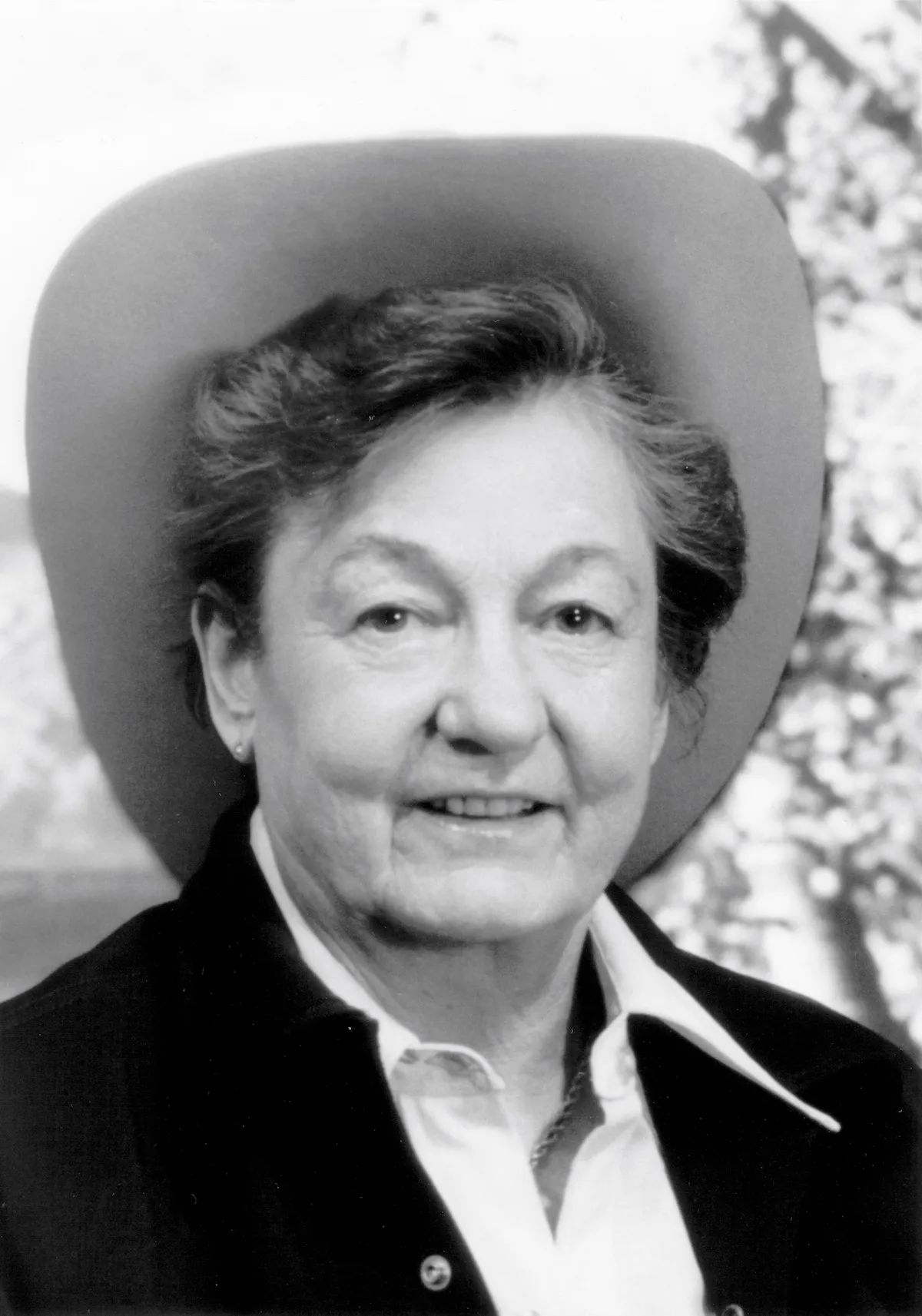
LEGACY INDUCTEE
BOBBY BROOKS KRAMER (1913-2005)
DISTRICT 2 - YEAR 2027
Bobby Brooks Kramer lived a life that spanned nearly a century of change while creating an identity and legacy intertwined and even defining Western heritage and tradition. Born December 1, 1913, in Terry, Montana, to Edwin and Violet (Davison) Brooks, she joined her older brothers List and Lafe, completing the family. She was born Lemeral Lenora Ovida Brooks, a name chosen by her grandmothers, and as a girl was called Lemmy. After her hair was cut short, people began calling her Bobby, a name she later took legally when she was about eighteen.
Bobby's childhood was a time when horses were a major part of the work. She understood horses from the ground up. It is said she broke her first horse at age eight, and her father once predicted that her fearless nature would keep her from reaching sixteen. At age 14 or 15, while Bobby trailed a couple hundred horses solo from Terry to Broadus, she lost her saddlehorse along the way, later found him but became lost in the search. She spent several nights on her own before making her way back to the Yellowstone and into Miles City.
She was one of the first women to ride broncs for prize money. In 1931 at the age of 18, she was offered twenty-five dollars by a stock promoter at the Wolf Point Stampede if she could ride a bronc to the whistle. The offer came after she had lost her own twenty-five dollars gambling. She accepted the offer and recovered her lost money. Later, her life of riding included not only rough stock, but cutting, reining, endurance riding, and polo, and the everyday ranch work that made those public accomplishments possible.
Bobby married Corwin Allen 'Bud' Kramer on July 24, 1943, in Billings. While Bud was serving in the U.S. Army, Bobby stayed home and handled their stock and rodeoing until his return. The couple built what became a sizeable ranch in eastern Montana. At its largest, their ranch included 76,000 deeded acres and 60,000 leased acres. The Kramers bought wild horses from ranchers throughout the region to be gathered from the range allowing the way for cattle. Handling 10,000 head of horses a year was common.
Bobby also belonged to the generation of Western women whose work expanded far beyond the saddle. In 1948, she attended Billings Business College and graduated from Beauty Operators School. She received her private pilot's license in 1964 and later earned a commercial license. She used airplanes to round up 'far-flung horses,' and her flying experience served her well in gathering wild horses. In 1962, she and Bud bought a ranch near Billings and later was joined by their adopted son, Gary Crowder, in forming the Kramer Crowder Horse Ranch.
The formal honors Bobby received reflect only part of her contribution to our Western heritage. In 1989, during the Great Montana Centennial Cattle Drive, she was selected at the age of 75 as one of two women among forty-four drovers. In 1990, she rode as grand marshal in the Miles City Bucking Horse Sale. Three years later she led the Billings parade celebrating the city's Diamond Jubilee. In 2000, she was inducted into the National Cowgirl Museum and Hall of Fame in Fort Worth, Texas, a tremendous honor recognizing her accomplishments as a cowgirl, rancher, and horsewoman from Montana.
Bobby's trophies and memberships show the breadth of her horsemanship. Her home was filled with plaques, trophies, and photos of horses she raised and trained. Her records include American Quarter Horse Association Register of Merits, AQHA Championships, many Montana Quarter Horse Association Hi-Point awards, and National Cutting Horse Association Certificates of Ability. She won the Carbon Acres Challenge Trophy which had to be won four times. She won six AQHA All-Around Championships in 1994, at the age of 81, when most people are long retired from competitive riding. She was a charter member of the Billings Saddle Club in 1939, a lifetime member of the American Quarter Horse Association, the Montana Quarter Horse Association, and the Montana Cutting Horse Association, and a member of the Billings Mounted Quadrille. She also helped form horse-related organizations, including the annual March of Dimes horseback rides.
Even late in life, Bobby remained active in the saddle. The Billings Gazette described her at age 83 as sitting sitting on her favorite copper-penny quarter horse, Red, joking that she was “pretty good for an old gal” and “terrible for a young one.” Around that age she was still cutting cows, practicing horsemanship, and giving advice about training colts. She carried visible marks of a life spent around horses, including a scar from the night a stud horse bit off the tip of her nose.
Public attention eventually caught up to the life she had lived so far. The Western Heritage Center in Billings featured a photo exhibit titled, “Bobby Brooks Kramer: A Montana Legend.” She also appeared in documentaries about women bronc riders, including I'll Ride That Horse and The Last Stronghold. A Quarter Horse Journal feature placed her among the Montana-born women riders who helped define Western horsemanship. Her recognitions, as one account noted, came from “strictly her doings” and not from the achievements of others.
Bobby died January 5, 2005, at age 91. Though small in stature, she left a legacy far larger than her physical presence commanded. She was preceded in death by her husband, Bud, who died in 1979, and she left behind family, friends, nieces and nephews, and a wide circle of people influenced by her riding, teaching, ranching, and example. Her ashes were buried in Jordan, Montana.
Bobby Brooks Kramer preserved and advanced the traditions of Montana ranching and Western horsemanship through a lifetime of direct participation and carried Montana's open-range spirit through nearly a century of change.
Sources:
Falstad, Jan. “Still Riding Free at 83.” The Billings Gazette, September 21, 1997, section E.
Bobby Kramer Obituary. Dahl Funeral Chapel, January 2005.
Bobby Brooks Kramer. Range Riders, Inc. Catalog of Plaque Mounted in Memorial Hall, Miles City, MT.