

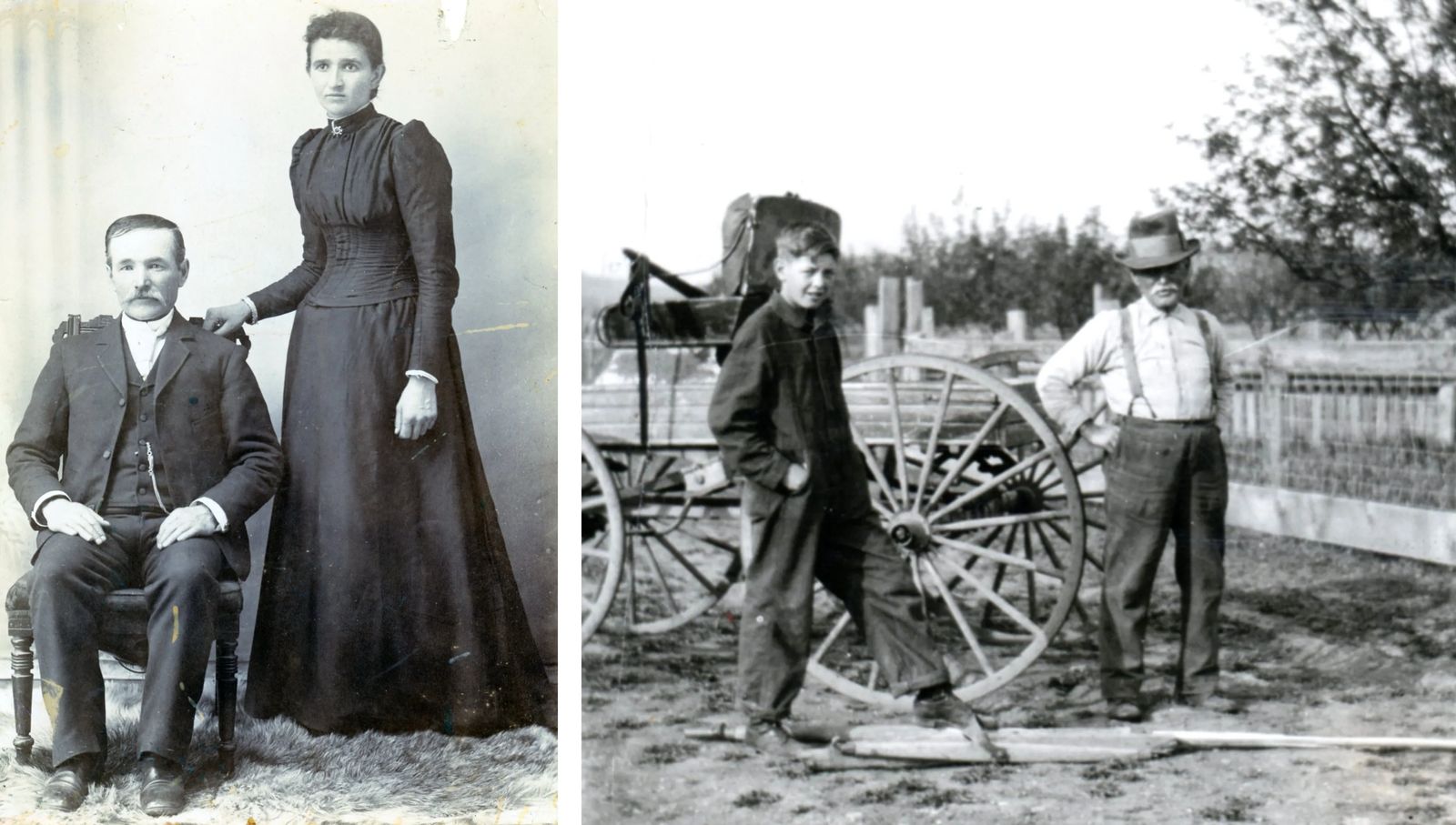
LEGACY INDUCTEE
ALEXANDER “ALEX” WIGHT (1842-1928)
DISTRICT 12 - YEAR 2027
Alexander Wight was born in Beverly, Ohio, October 14, 1842, the first-born son and one of six children of Francis and Eliza (Heger) Wight. At the age of ten, his family moved to a farm in Eldon, Iowa, where Alex continued his education until age 20. He was an exceptionally good student and had considered becoming a school master. He worked with his father and brother, Ephraim, on the family farm, plowing, seeding, and harvesting crops of corn and hay by hand. Alex dreamed about the West, and when he heard of a wagon train being assembled and was bound for Montana, he excitedly talked with his mother about joining, of which she objected, due to the dangers of such a trek. In 1864, at the age of 22, and after a day of a dispute with his brother, Alex decided to join the wagon train. He lovingly wrote a note to his mother, left her his last bit of money in the clock, and took off on foot to join the adventure.
The wagon train, owned by Andrew J. Davis, an Iowa native, who incidentally became the first millionaire in Montana, was loaded with general merchandise and headed for Virginia City. They also drove a herd of loose oxen and cattle as far as Atchison, Kansas, and there took on more supplies with which to cross the plains. These journeys were arduous and dangerous, especially the many river crossings. Alex’s job was to herd the loose cattle trailing behind the wagon train. He told of fording the rivers by hanging on to the tail of an ox. The trip to Virginia City took four months and seven days and upon his arrival, Alex briefly continued to work for Mr. Davis to pay off a small debt.
During the next few months, he secured odd jobs in Three Forks and Race Track, Montana. Alex heard of the discovery of gold by Ophir Gulch near Avon, Montana. He was struck with gold fever and acquired a claim in the Race Track Creek Placer and worked it for a time. Deciding that the claim was not profitable, he sold it for the sum of $150.00. He leased land at Race Track from his acquaintance, A.J. Davis, planting 75 acres of oats and wheat, which initially did well until the entire crop was destroyed by grasshoppers. Following this disaster, Alex surrendered his lease to Henry Frederickson, a close friend of Conrad Kohrs, and worked for Henry, receiving a yoke of oxen as his wages. From there he moved to Philipsburg, Montana, where he freighted until he acquired a contract with the Hope Mining Company in Granite, north of Philipsburg, for hauling 600 cords of wood at $3.00 per cord.
Increasing his freighting outfit to seven yoke of oxen and three wagons, Alex continued to freight with enough profit to enable him to take his livestock and property to his newly filed claim in the Lower Flint Creek Valley near Stone, Montana, in 1869. He chose this location because he had camped there many times and discovered several natural springs which never froze in the winter. The area was heavily timbered with ample game including buffalo, deer, and antelope as well as abundant grazing for his oxen.
Over the next 59 years, Alex developed the land into a sizeable ranch with subsequent purchases until he became the largest landowner in Granite County. Alex, a confirmed bachelor, built his first homestead cabin and several outbuildings to support his operation. He grew his livestock herd to more than 10,000 sheep and 200 head of cattle while also raising fine crops of grain and hay. Alex hired knowledgeable sheepherders who were crucial to his success in the sheep business.
While living in Montana, Alex penned beautiful and descriptive letters to his family in Iowa reporting of his hardships and successes including unpredictable weather, progress of crops, and results of calving, lambing, and shearing. Alex’s letters were threaded with stories of isolation and loneliness. News from home was welcome indeed. About 1881, his sister Mary and brother-in-law Tom Parks came by stagecoach to work on the ranch with Alex. Mary fretted about the dangers of this strange and wild new land, and the couple eventually returned home. Later another of Alex’s younger sisters, Ruth, and her husband, Martin Minear, came to assist on the ranch but, like her sister, also returned to Iowa.
In 1891 at the age of 49, Alex briefly returned to Iowa to marry a family neighbor, 24-year-old Catherine Heger. The newlyweds immediately returned to the ranch at Stone. Despite hardships ahead, several neighbors helped Catherine adjust to the ranch life in the West. To ease the transition, Alex built Catherine a fine home with dove-tailed logs, regarded as one of the most desirable homes in the valley. As with many pioneer families, life wasn’t easy for the couple. They had seven children and of these, one girl Eliza died of appendicitis at age eight, a boy George died of pneumonia at age six, and another daughter, lovingly named, died at birth. Their remaining four children who lived to adulthood were two daughters, Ruth Hocket and Mary Jensen, and two sons, Francis and Ernest Wight.
Alex was a force to reckon with. He stood five foot three, was sturdily built with good wide shoulders, and his eyes were sky-blue. According to his children, he was a strict disciplinarian and when he spoke “you heard him the first time.” Alex was a successful business man, a progressive member of the community, and proudly sported one of the first automobiles in Granite County. Active in the community, he served as a Granite County Commissioner, was elected president of the Granite County Bank, and was a founding member of the Methodist Church in Hall, Montana.
Alex died at his home near Stone on May 14, 1928, at the age of 85, with his funeral at the Methodist Church in Hall and burial in the Valley Cemetery at New Chicago near Drummond, Montana. The funeral procession of nearly 200 automobiles was thought to be one of the largest ever seen in Granite County.
Prior to Alex’s death, he gave equal land allotments to his four children. Today, his beloved ranch remains as two separate working cattle ranches owned and managed by his great-grandchildren and great-great grandchildren.
Alexander Wight’s remarkable legacy is a testament of the resilience and ambition of those who believed in the promise of the great state of Montana.
Resources:
Jensen, Mary Wight. 1992. Mary Jensen’s Memoirs. Unpublished Memoir.
Myers, Frank D. “The Iowaville Roster: Andrew Jackson Davis.” 19 September 2008. Google. The Lucas Countyan: The Iowaville Roster: Andrew Jackson Davis.
Progressive Men of the State of Montana (Volume pt. 2). Chicago: Bowen, A.W., & Co. (No date of publication).
Jurors Summoned to Appear at the December Term, 2d Judicial District. The New North-west. December 04, 1885. Chroniclingamerica.loc.gov. Library of Congress.
Fatal Accident. Death of Henry C. Frederickson. The New North-west. January 20, 1871. Chroniclingamerica.loc.gov. Library of Congress.
Trial of J.J. Kennedy: For the Killing of Thomas H. O’Conner at Griff Creek. The New North-west. June 21, 1879. April 23, 1880. Chroniclingamerica.loc.gov. Library of Congress.
Notice To Miners: U.S. Land Office, Helena, M.T. The New North-west. August 23, 1878. Chroniclingamerica.loc.gov. Library of Congress.
Wight: Valley Pioneer Family. Granite County History. 11 April 2020. Google. https://granitecountyhistory.blogspot.com/2020/04/wight-valley-pioneer-family.html