

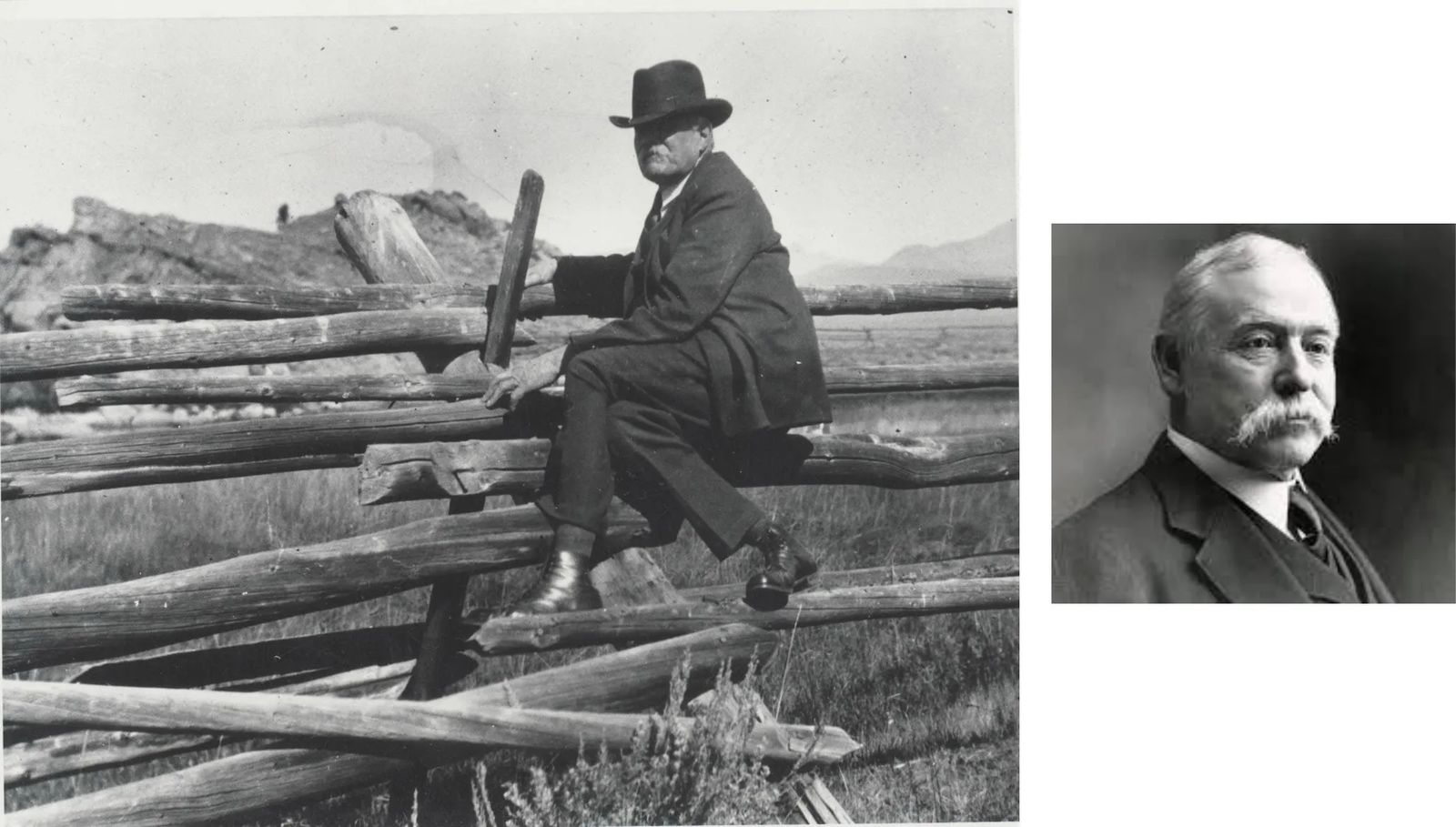
LEGACY INDUCTEE
MARCUS DALY (1841 - 1900)
DISTRICT 11 - 2027
Marcus O’Daly was born in County Cavan, Ireland, on December 5, 1841, to Luke and Mary (Coyle) Daly. Legend has it that Luke O’Daly once spent his last dollar betting on a racehorse. A farmer in County Cavan, O’Daly could not offer his six children much beyond subsistence, but to Marcus he passed on his love for fast, beautiful horses.
Fifteen-year-old Marcus left Ireland and sailed for America in 1856, landing at New York Harbor. He worked as a newspaper and errand boy and at a leatherworks factory. On the Brooklyn docks as a stevedore, that’s where Marcus heard tales of quick fortunes unearthed in California’s northern goldfields. In 1861, he bought ship passage to San Francisco.
In Calaveras County, California, Marcus learned the hand-blistering work of hard-rock mining with shovel and pickax. His surname O’Daly shortened to Daly somewhere between California and his arrival at the Comstock Lode in Nevada. By way of thorough study of rocks, soils, and minerals, Marcus became a self-taught “master” in assessing mineral veins as well as tunneling, timbering, and blasting.
In Utah at the Alta camp in 1870, Marcus rose to foreman of the Walker brothers’ silver mines. Two years later, he was leading a round of inspections of the Walker mines. Zenos Evans and his daughter, Margaret, were among the guests. Marcus hopped into a trench, scooped up a piece of ore, and held it up for his audience. As legend has it, eighteen-year-old Margaret, wanting a closer look, lost her footing and tumbled into Marcus’s arms. The tumble led to a courtship and twenty-eight-year marriage that would end with Marcus’s death. They would raise four children, Madge, Mary, Marcus II, and Harriet.
The Walkers made Marcus a partner in ownership of the Alice Mine, but he’d leave their employ to strike it out on his own. He sold his Alice Mine shares to the Walkers for $30,000 and moved his family to the Butte mining camp in Montana Territory. There, Marcus paid $30,000 for full interest in the Anaconda Mine. One day in 1882 at three hundred feet underground, the Anaconda’s rock-ribbed walls shuddered from intermittent drilling and blasting. A section of rock shattered, dust cleared, and Marcus picked up a piece of glance from the dirt floor. The vein from which it fell was solid copper.
The discovery marked one of world’s greatest concentrations of copper. And the timing was perfect. Demand for copper was on the threshold of skyrocketing as electric power infrastructure advanced across the world. Marcus and three partners founded the Anaconda Mining Company in 1891. This and his other enterprises - timber, railroads, coal, and banking - employed thousands of men “at the best wages known,” the Ravalli Republican stated. He loathed the title that was ascribed to him, “Copper King,” possibly as much as he loathed cheap wages. Anaconda Mining Company crews earned wages ranging from $3.50 to $5.00 per day. No other company in the region in the 1890s matched those wages. Marcus’s belief that good wages fostered a permanent and skilled workforce also fostered a prosperous and stable community in which the workers lived.
After the purchase of multiple ranches in the Bitterroot Valley, Marcus founded the Bitter Root Stock Farm where he began raising Thoroughbred and Standardbred horses. Marcus said, “I have a theory that Montana will produce the best horses of the world and I am testing it. The climate here is cold, but the air is pure, and it increases the lung power of the horses. As to the coldness of the climate and the charge that colts will not grow here in the winter, if this is true, I expect to overcome it by good stabling and good food. Our grass here is better than that of California or Kentucky, and it makes better bones and better feed.” Mindful of the men employed at the farm and at his sawmills, Marcus directed James W. Hamilton to plat a new townsite for the workers. Founded in August 1890, the site named Hamilton survives today as a thriving and growing town.
Through the 1890s at Bitter Root Stock Farm, as many as five hundred people cared for more than one thousand head of Thoroughbred and Standardbred horses. Marcus bred them, raced them, and they won several of American horse racing’s most prestigious races on eastern racetracks. Among the most famous of his Thoroughbred racehorses were Montana, Tammany, Ogden, and Hamburg. Scottish Chieftain, winner of the 1897 Belmont Stakes, would be inducted into the Montana Cowboy Hall of Fame, Class of 2015. Marcus was also a staunch supporter of horse racing in Butte and Anaconda. He granted his work crews half a day off with pay to attend the races. Most of them backed the boss’s horses because they knew he raced high-quality animals and employed good handlers. Marcus would breed and race Thoroughbred and Standardbred horses until his death.
By 1900, Marcus had trailblazed the West’s mining and smelting industries, co-founded the world’s largest copper-producing company, and with his champion racehorses, he had stamped a Montana imprint on American horse racing.
Years of exposure to noxious dust and fumes weakened Marcus’s health. He died in New York City on November 12, 1900, at age 56. When news of his death reached Butte and his company town of Anaconda, both were draped in black. Flags on mine hoists floated at half-mast. The Bozeman Chronicle stated that his “secret and unostentatious charity and helpfulness was felt in a thousand ways that the world never heard of.” His fortune was estimated at $25 million.
Throughout Montana’s storied history, few of her citizens shaped a legacy as tremendous and far-reaching as did Marcus Daly. He rests in the Daly mausoleum at Greenwood Cemetery in Brooklyn, New York.
Source:
Catharine Melin-Moser, When Montana Outraced the East: The Reign of Western Thoroughbreds, 1886-1900 (Norman, OK: Oklahoma University Press), 2025.
Photograph of Marcus is courtesy of the Marcus Daly Mansion Archives, Hamilton, Montana.