

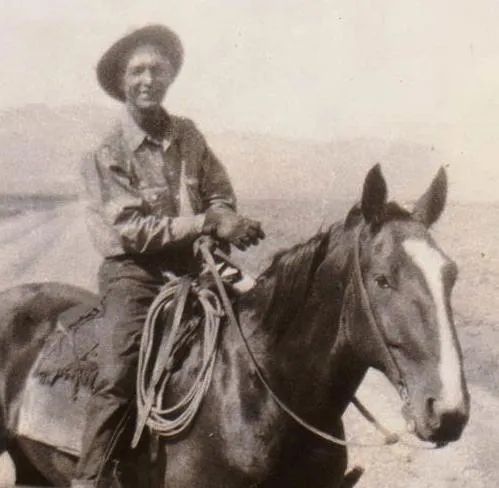
Montana Cowboy Hall of Fame INDUCTEE 2014
Raymond Andrew Kannegard (1893-1975)
In 1881 Andrew and Anna (Johnson) Kannegard left Denmark and came to America. Not being able to speak or translate the English language they were mistakenly given Anna’s maiden name, Johnson. It would be some years later when the eldest children realized that their last name was incorrect and were able to ultimately change it back to Kannegard.
In 1888 Andrew and Anna moved west with their family to the Montana Territory, in search of the land of opportunity, before Montana was a state. Upon arrival to Montana, the Kannegard’s chose a homestead site on Elk Ridge located in the northeastern part of the Bridger Mountains.
On January 19, 1893, Raymond Andrew Kannegard was born at the family ranch near Sedan, Montana. Raymond attended the Sage Brush School located in Gallatin County not far from the original homestead. He went to this school up to the eighth grade. Raymond had three full brothers, Clark, Denver, Elmore, and adopted brother Harry Davis.
In 1914 Raymond worked as a freighter. He had a six string mule team which pulled a grain tank which held 9000 pounds of wheat. He also pulled a trail wagon which contained 75 more bushels of wheat. Kannegard was quoted as saying “every driver carried his whip with his lines,” however, “no good long-line man shook his lines at his horses, a la TV.”
In 1918 Raymond’s first wife Sadie passed away, having succumbed to the flu during the epidemic. Raymond and Sadie had a daughter named Cleo. After a time, Raymond moved on and married Dolly McNamer. They had three daughters Shirley, Dolly Jo, and Alice Jane. Raymond and Dolly settled in the Sedan area where they ranched, raised cattle and American Saddlebred and Quarter Horses. He rode for his brand, the Lazy Wineglass.
In the 1920s there were ranch rodeos held at the Woosley ranch and Raymond was the rodeo announcer.
Raymond was the quintessential cowboy. He understood horses, and had a special ability to know if a horse was going to be a good addition to the herd, or if it should be sent down the road. He was a quiet man that did not believe that a horse needed to be “broke”. Raymond in a sense was a true horse whisper of his time. He never believed in using a whip or striking a horse.
In the winter, to help supplement their income, he trapped beaver, mink, wolves, and other fur bearing animals that were plentiful on their ranch. He even said that beaver were good eating. I guess we will take his word for it.
Like most ranchers, Raymond faced hardships, such as when lightning struck his horse Connelly while they were checking stock. Unfortunately, the strike killed Connelly, and Raymond ended up in the hospital for a week. He was very fortunate to have survived.
Raymond loved riding his beloved horse Socks in many of the Wilsall parades on rodeo weekend.
Raymond was a voracious reader and knew history better than anyone I know. He used to tease everyone who read Zane Grey and Louis L’Amour books and would always tell them it would ruin them.
During his last years on this earth, Raymond was content to get in his trusty old truck with his dog Felix and go out to the Henry Guth Hereford Ranch. He would spend his day irrigating, tending to cattle, riding horses and doing the many things that are needed to be done to keep a ranch going. He would take his shirt off about April so he could get a good “glow” and put it back on again in September. Raymond did not fear the dangers that could ensue from too much exposure to the sun. He was from a different era, one that we envy today. Life could be harsh and unforgiving, but for Raymond and the other cowboys it was a land of freedom and being able to do what they loved.
Raymond's neighbor, Edgar Rexroat, formerly a Sedan resident, described Raymond as “the last of the old time cowboys.”
Raymond died October 12, 1975. His epitaph reads: A Cowboy’s Cowboy.